

1. WHAT IS ITR-1 ?
ITR-1 (Sahaj) is a simplified income tax return from available to eligible resident individuals with total income up to Rs 50 lakh from specified sources such as salary/pension, up to two house properties, certain other sources of income, agricultural income up to Rs 5,000 and eligible LTCG under sec 112A up to Rs 1.25 Lakh.
Types of Income Tax Return
- ITR 1(also known as SAHAJ) for individuals.
- ITR 2 for individuals/HUFs not eligible for ITR-1 and without business/profession income.
- ITR 3 for individuals/HUFs having business/Profession income.
- ITR 4 for individuals declaring income under presumptive scheme.
- ITR 5 for llp & partnership firms.
- ITR-6 for companies.
- ITR-7 for ngo, trust, societies claiming benefits of 12a & 80g.
2. WHO IS ELIGIBLE TO FILE ITR-1?
Only resident individual whose total income does not exceed ₹ 50,00,000 and who has income from following sources of income only can file ITR-1
|
Particular |
ITR-1 AY 2026-27 |
|
Who can use it ? |
Eligible resident individual |
|
Total Income |
Up to Rs 50 Lakh |
|
Salary/Pension |
Yes |
|
House Property |
Up to 2 House Property |
|
Family Pension |
Yes |
|
Agriculture Income |
Up to Rs 5,000 |
|
LTCg u/s 112A |
Up to Rs 1.25 Lakh |
- Income from Salary.
- Income from House Property (up to two House property).
- Long-Term Capital gain under sec 112A up to Rs 1.25 Lakh. (Example - If resident individual has salary income of rs 8 lakh and LTCG under sec 112A of Rs 90,000, the taxpayer may still eligible for ITR-1)
- Agriculture income (Up to ₹ 5,000 only)
- Income from other sources namely:
- Interest from saving bank accounts.
- Interest from deposits.
- Interest from income tax refund.
- Family pension
- Interest received on enhanced compensation.
- Any other interest income.
3. Who Cannot File ITR-1 ?
ITR-1 cannot be filed by an Individual who:
- Is a resident but not ordinarily resident (RNOR) or who is a Non– Resident Indian (NRI).
- Has total income exceeding ₹ 50 lakh.
- Short Term Capital gains
- Long Term capital gains exceeding Rs 1.25 Lakh
- Foreign Asset/Financial Interests.
- Signing authority in foreign account.
- Foreign Source Income.
- Is a director in a company.
- Has invested in unlisted equity shares.
- Has income from business/ profession.
- Brought-forward/carry-forward losses.
- Has tax deduction under Section 194N of income tax act (TDS on cash withdrawn).
- Has deferred income tax on ESOP received from employer being an eligible startup.
4. TYPES OF INCOME THAT CANNOT BE SHOWN IN ITR 1
Following are the types of income which will not form part of ITR 1-
- Profit/ loss from business/ profession.
- Long-Term Capital gain under sec 112A exceeding Rs 1.25 Lakh.
- Income to be apportioned in accordance with the provisions of section 5A.
- Income from other sources of nature as specified: -
- Winnings from lottery.
- Activity of owning and maintain racehorses.
- Income taxable at specified rates under section 115BBDA or 115BBE.
5. Can I File ITR-1 if I have capital gains ?
Situation 1
Salary + eligible section 112A LTCG up to Rs 1.25 lakh - potentially ITR-1
Situation 2
Salary + Short term Capital gain - ITR-1 not available
Situation 3
Salary + section 112A LTCG above Rs 1.25 Lakh - ITR-1 not available
6. DOCUMENTS REQUIRED
Following documents are required while filing ITR-1: -
- FORM 16 from your employer.
- Interest certificates from banks. Post office, Nbfc etc.
- FORM 26AS.
- AIS/TIS details.
- Dividend Details
- House Property information where applicable
- Details of Capital gains, where applicable
- Investment details (if any).
- Donation receipts.
NOTE:
Since ITR’s are annexure less forms the above-mentioned documents are not to be attached with the ITR Form. However, one needs to keep these documents as it can be demanded by the tax authorities during assessment, inquires.
The taxpayer should reconcile the information in Form 16, AIS, TIS and Form 26AS before Submitting the return.
7. HOW TO FILE ITR-1?
By following the steps mentioned below one can file ITR-1
Step -1 Visit the income tax portal by clicking on the following link

Step -2 Click on login and enter your pan & password to login to the income tax portal


Step -3 Click on e-file, then click on file income tax returns.

Step -4 Select the assessment year for which you want to file ITR and select the mode of filing (here we are telling about online filing procedure)

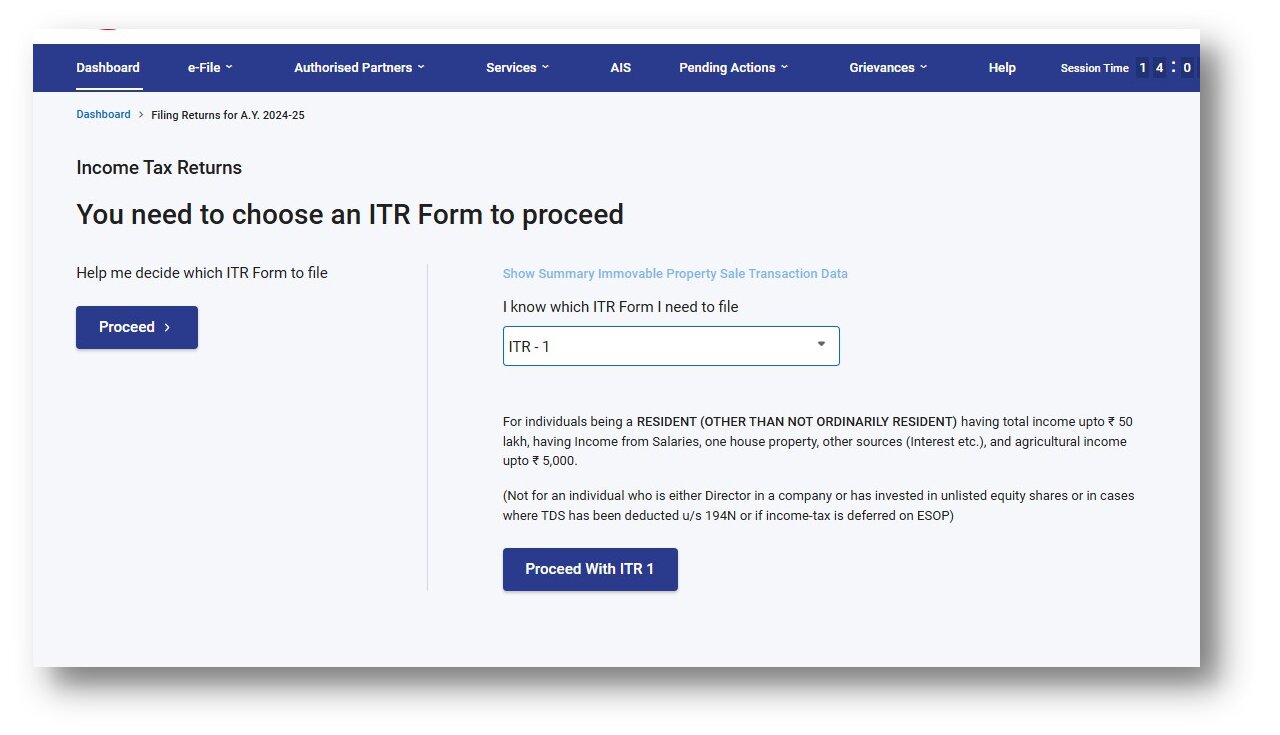
Step -5 Click on continue and select the ITR form i.e ITR-1 in our case.

Step -6 Click on continue, the form will appear the first step is to fill the basic information & click confirm. In this step up need at least one pre validated bank to go to further step to file your return.

Step -7 Second step is to fill the income details the different sources of income one has like income from salary, house property or other sources.

Step -8 The next step is to claim the deductions that you are entitled to claim under various sections like 80g, 80d, 80c etc.

Step -9 The next step is to verify the details of taxed paid by you including the TDS deducted and TCS collected from you

Step - 10 The next step is to click on total tax liability, wherein the system will automatically calculate your tax liability and if taxes paid is greater than the tax liability you will be entitled to get a refund and if the tax liability is more than the taxes paid then pay the remaining tax liability.

Step -11 After that click on preview return and verify the inputs provided by you.

Step -12 Click on proceed to validation, if any error occurs clear the error and click on proceed to verification.

Step -13 The last step is to verify the return prepared you can verify the return through following methods: -
- Through Aadhar OTP.
- Through digital signature (DSC)
- Through pre validated bank account
- Through pre validated demat account
- Through Net banking.
- By sending signed physical copy to the Income tax department, Bengaluru.

- After verification of the return, your return will be finally submitted to the Income Tax department for further verification.
8. Common Mistakes while Filing ITR-1
- Selecting the wrong ITR Form
- Ignoring AIS/TIS differences
- Forgetting bank interest
- Not reporting dividend Income
- Entering Incorrect Tds
- Claiming deductions without checking eligibility
- Selecting the wrong assesment year
- Forgetting to e-verify the return
- Using ITR-1 despite having ineligible capital gains
- Not checking house property income.
9. Practical Examples of ITR-1 Eligibility
Example 1 - Salaried Person
Rahul earns Rs 9 lakh salary Rs 35,000 bank interest and has one property. Assuming he satisfies the other eligiblity conditions, ITR-1 may be applicable.
Example 2 - Two House Properties
A resident individual salary income and income from two house properties. ITR-1 rules allow eligible taxpayers to report up to two house properties.
Example 3 - Short term Capital gain
A salaried Taxpayer earn Rs 8 Lakh salary and Rs 45,000 short term capital gain from shares. Itr-1 cannot be used merely because total income is below Rs 50 lakh.
Frequently Asked Questions
1. What is the Income Limit for ITR-1 ?
For AY 2026-27, ITR-1 is generally applicable where the individuals total income does not exceed Rs 50 Lakh, subject to the specific eligibility conditions of the form.
2. Can an NRI file ITR-1 ?
No, ITR-1 is meant for a resident individual other than a Not ordinary Resident (RNOR). Therefore a Non-Resident Indian cannot use ITR-1.
3. Can I file ITR-1 have short term capital gains from shares ?
No, A person having short term capital gains cannot use ITR-1.
4. Can I file ITR-1 if I have LTCG under Sec 112A?
Yes in certain cases. For AY 2026-27 eligible individuals can use ITR-1 where long term capital gains under sec 112A do not exceed Rs 1.25 Lakh.